
UNDERSTANDING MESH SPECIFICATIONS
The openness factor of screen mesh is specified by the yarn density and yarn diameter. The “warp” and “fill”, that is, the number of yarn threads per inch “warp” by the number of yarn threads per inch “fill” specifies the yarn density. Thus, 20x20 mesh is twenty threads per inch warp, and twenty threads per inch fill. The larger the warp and fill numbers and the larger the yarn diameter the tighter the weave, the smaller the openings between the threads, the smaller the insects it will control, the greater the reduction in air flow and the greater reduction in light and visual transmittance. Solar factors are specified for screen mesh also. Each screen mesh is specified as to its solar transmittance, solar reflectance and solar absorbance.
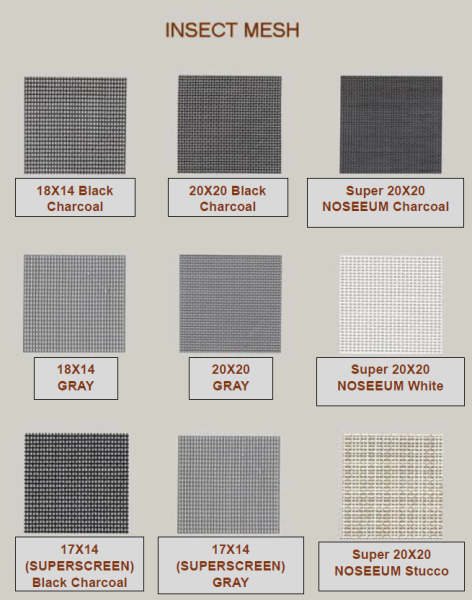
SCREENING FOR INSECT CONTROL:
For maximum control of insects, including the smallest ones, you want to select the screen mesh for smallest openness factor. This means high warp and fill and yarn diameter. However, the downside of small openness factor is reduced air flow and light transmittance. The room will be darker and on hot days it will suffer from lack of air movement. Therefore, it must be kept in mind that screen selection is a compromise. If the room is fitted with lights and fans a screen mesh can be selected to minimize the openness factor such as 20X30. If you are depending on air movement from outside, a mesh with a higher openness factor such as 20X20 will allow more air flow and restrict all (including no-seeums) but the smallest insects. For maximum airflow 18X14 mesh is best. If the lights are going to be on at night you will want to use 20X30 and fans for cooling. This is because at night the smallest insects, attracted to the light, will land on the screen and squeeze through and continue to the light.
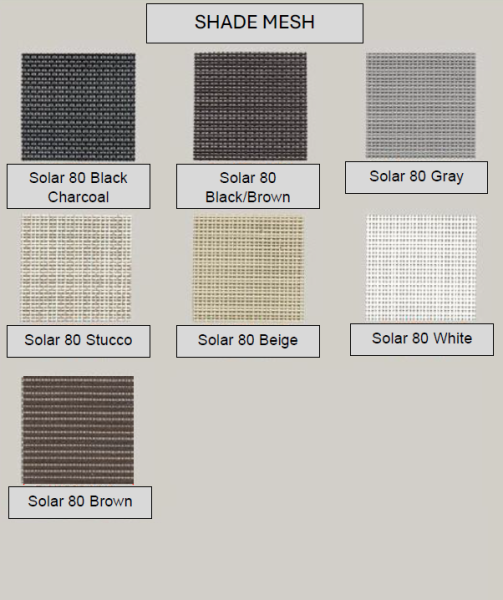
SCREENING FOR SUN CONTROL
Solar transmittance is the amount of solar energy that passes through the openings and thus is proportional to the openness factor. The tighter the weave the less solar transmittance can result. Solar reflectance is the amount of solar radiation reflected. Again, a tighter weave gives more solar reflectance, but the lighter the color also the higher the reflectance. Solar absorbance increases with tighter weave and darker colors. The problem with high absorbance is that approximately one half the solar energy absorbed by the screen mesh is re-radiated back into the room. The sum of the percentages of transmittance, reflectance and absorbance must equal one hundred percent of the solar energy incident on the screen mesh. Ideally you want to maximize reflectance and minimize absorbance for any particular mesh density. This means the lighter the mesh color the better for sun control. Again, air flow is compromised by lowering the transmittance since to do so means to reduce the openness factor.
Dealers Wanted
Partner with Screen America. Keep the bugs away with SKEET’R BEAT’R. Dealer inquiries are welcome! Contact Screen America Corporation today!
Call Now to Get Started!
Looking for the perfect screen or shutter solution? Contact Screen America Corporation today at 352-628-5512.
Our team is here to assist you with expert advice, product options, and dealer inquiries.
Situated along Florida's "nature coast", our factory and administrive office complex is loacted at:
7269 W. Homosassa Trail
Homosassa, FL 34448